











When purchasing soft trims, TPU often appears among the candidate materials. Aimed at purchasing and product design staff, this article sorts out which trim parts TPU is suited to take on, and several conditions that need to be clearly communicated before requesting a quote.
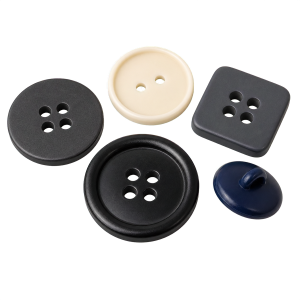
What is TPU, and why does it often appear in soft trims?
TPU refers to thermoplastic polyurethane, a type of elastomer material. Material suppliers describe it as combining elasticity, wear resistance, and mechanical strength, while also having some resistance to oils, greases, and various chemicals, and being usable over a wide temperature range. The practical takeaway for trim sourcing is: it covers a very wide range of hand feel, and the same type of material can simultaneously supply both soft hand feel and relatively firm setting requirements, so you cannot look only at “whether TPU is used,” but also at which grade is used.
A more useful point for procurement is its soft-to-hard range. Supplier-published grade-series information shows that Shore hardness can cover a range from very low to relatively hard; for example, ether-based series are about 50A to 75D, some series as low as 35A, and some series as high as above 90A, even 95D and 98A. That is, saying only “TPU” is not enough to determine hand feel; the hardness grade must be confirmed with the supplier as a separate item.
Common forms in apparel accessories: films, appliqués, and connectors
In apparel and textile applications, TPU is most commonly used in film form. Typical uses include breathable waterproof films, weatherproof films for functional apparel, and film layers laminated with other fabrics. When sourcing, focus on waterproof and breathable performance, elasticity, and the overall hand feel after bonding to fabric, rather than a single metric of the film itself.
TPU films are also used for appliqué-style decorations on apparel, such as letter and number appliqués, and for components joined by heat sealing. These applications value the bonding effect with the fabric and the visual presentation, so the fabric type, bonding method, and expected wash resistance requirements all need to be specified together.
Structural accessories may also use TPU. Take drawstring adjustment accessories as an example: the material options for cord locks list PA, POM, PP, TPU, etc., indicating that TPU is one of the options that can be included in the evaluation. The final choice should be determined based on the structure and usage requirements of the part, rather than defaulting to TPU for all.
Common forms in bags and protective accessories: cushioning, wrapping, and strap components
In luggage accessories and protective products, the common role of TPU is as a cushioning layer and a wear-resistant covering layer. Taking sports protective products such as knee pads as an example, the product page lists PP, PE, and TPU as optional materials, chosen according to protection level and hand feel, with hardness and structural design adjustable. Which grade is used for a specific part and whether TPU is used must be evaluated based on drawings and confirmed samples; the product page itself does not draw conclusions about which materials are more or less suitable.
In the area of tapes and profiles, TPU is also used for extruded tapes, profiles, and films. For luggage, this means that accessories appearing in tape or film form, such as webbing edge treatment, handle wrapping, and anti-wear strips, may all involve TPU solutions. Whether TPU is actually needed depends on whether the part requires elasticity and wear resistance, and whether it must not become brittle and crack under repeated bending.
Scope of Application and Boundaries
TPU is not a universal solution for all accessory parts. Which parts can be used and which hardness grade to use must be evaluated item by item in combination with drawings, confirmed samples, and actual usage conditions; for parts exposed to high temperatures or special chemical environments for long periods, first confirm whether the corresponding grade family covers those conditions. The above application directions come from the material supplier's public descriptions and our factory's material selection range for accessories, and do not replace confirmation for specific projects.
Frequently Asked Questions
How should hardness and appearance requirements be described when requesting a quote?
It is advisable to first describe the requirements in terms of hand feel and appearance rather than first asking about the material grade. For hand feel, you can directly say 'soft and resilient' or 'firm and shape-holding'; for appearance, state whether transparency, high gloss, or a more matte finish is required. Within TPU grade families, there are highly transparent options and aliphatic options with relatively stable long-term color; different grade families perform differently in transparency and yellowing resistance. Only when the appearance requirements are clearly stated can the supplier provide an evaluable range.
How should abrasion resistance and durability requirements be communicated effectively?
Explaining requirements based on how the part actually contacts other surfaces is more useful than reporting only an 'abrasion resistance rating.' TPU itself is known for abrasion resistance and tear resistance, but whether the part undergoes long-term reciprocating friction, occasional scratching, or repeated folding has different implications for material selection. By clearly explaining the use scenario, the contact counterpart, and the expected service life, the supplier can determine which type of performance should be prioritized, rather than giving a general answer of 'abrasion-resistant enough.'
What needs to be communicated in advance for a TPU part to mate with adjacent components?
The first thing to clarify is what it connects to and how it is connected. TPU film can be bonded to substrates such as fabric and foam through lamination or heat sealing, and different joining methods have different requirements for film type and surface condition. Stating in advance whether the adjacent component is fabric, foam, or rigid plastic can reduce repeated sampling.
The second point concerns mating dimensions, such as hole diameter, cord diameter, travel stroke, and connecting slot position. Taking drawstring hardware as an example, the hole diameter, cord cross-section, travel stroke, and installation fit of the connecting slot all need to be evaluated per project, and the drawings and approved samples shall prevail. Actual conditions such as fabric thickness, cord thickness, and assembly space determine whether TPU parts can fit stably; an outline drawing alone is often not enough.