












Side-release buckles of the same size differ in prong shape, release method and webbing-thread end design, so the opening and closing experience differs when they are mounted on the chest, shoulder strap or side of a bag. This article helps procurement write wearing position, operating space, webbing specification and verification items into the inquiry, and confirm feel and resistance to accidental opening with samples rather than comparing appearance only.
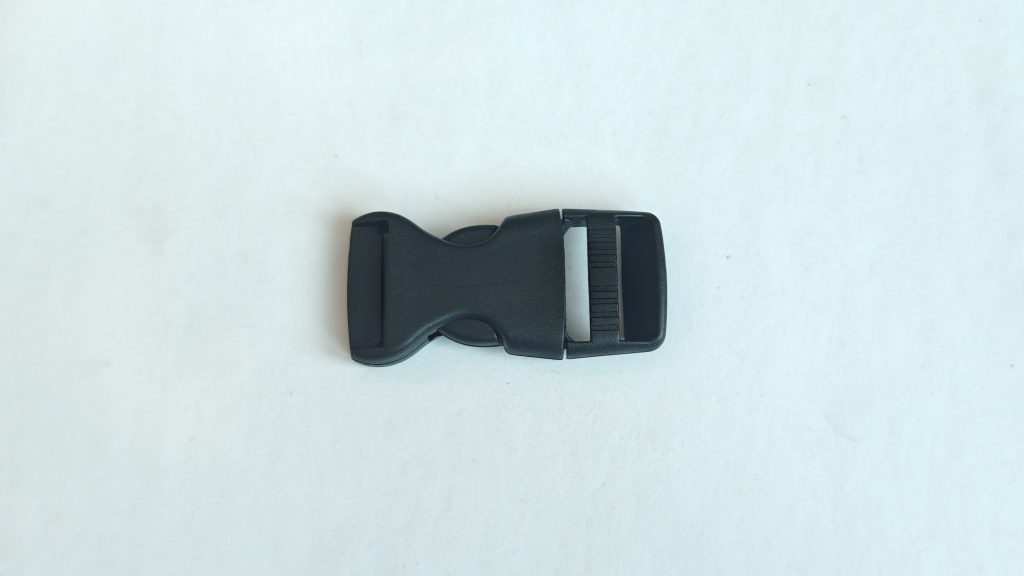
The prong structure determines how the fingers press and where they press
A side-release buckle (side-opening buckle) consists of a male buckle and a female buckle that mate together. The male buckle has flexible prongs on both sides; pressing the prongs on both sides separates the male and female buckles. It is used for webbing connection and opening/closing. A common male buckle also has a webbing adjustment bar at one end, which works with the threading method to adjust strap length. When purchasing, first confirm whether the prongs are exposed press arms or recessed trigger tabs with protective wings, because this directly determines the size of the finger contact area and the pressing direction.
The pressing experience differs among different structures. Some products use an integrally molded trigger tab that conforms to the hand shape, making release easier and more comfortable; for styles with a locking structure, the sequence of unlocking and pressing must be confirmed with the supplier, and the operating steps should be confirmed by trial-opening a sample. When requesting a quote, you may ask the supplier to state whether this style is simple press-to-release or has an additional locking action.
For procurement, you can include in the inquiry "the pressing direction of the prongs, the shape of the trigger tab, whether there are protective wings or a locking structure, and the sequence of unlocking and pressing," and require samples of the same specification to actually press several times to confirm whether the finger contact points and force are suitable, rather than judging only from appearance drawings.
When mounted on the chest, shoulder strap, or side of a bag, how much operating space should be left
A side-release buckle requires two fingers to squeeze and press from both sides simultaneously, and the wearing position determines whether this can be done. In the inquiry, state the mounting position and orientation of the buckle body, and ask the supplier to assess whether there is pressing space on both sides for that position. The feasibility of chest, close-fitting shoulder strap, or bag-side positions should be confirmed by trial-opening a sample in the worn state, and should not be judged only from appearance drawings.
If the position sits close to the body or the webbing is thick, ask the supplier to assess whether the buckle body shape and the fixed-end and adjustment-end solutions need to be adjusted. These are customization items evaluated according to the installation position and must be confirmed item by item with the supplier.
For scenarios with high requirements for preventing accidental opening, such as backpacks, soft luggage and children's products, the wearing state should be simulated on the sample to check whether external objects such as clothing, straps or adjacent webbing will press against the buckle legs, and the risk of accidental opening should be judged in combination with the release method explained by the supplier.
Retention force, accidental-opening prevention and repeated opening and closing: include them in the sample verification checklist
Scenarios such as backpacks, soft luggage and children's products have different requirements for preventing accidental opening. Some buckle bodies are designed with accidental-opening prevention as the goal, and some are equipped with a locking structure, so the unlocking method must be confirmed before operation. During procurement, the accidental-opening prevention requirements corresponding to the use scenario should be stated clearly, and the supplier should be asked to explain which release method the model belongs to, rather than making assumptions on your own.
Retention force, repeated opening and closing performance and webbing anti-slip effect cannot be judged from documents alone; verification should be based on matched samples under actual webbing and stitching conditions. The verification checklist may list: actual webbing specifications, buckle installation position, opening and closing method, and whether the pressing feel changes after repeated opening and closing. These verification items are agreed by the buyer and seller at the sample stage; public documents do not provide unified thresholds.
For materials, thermoplastic materials such as POM and PA can be evaluated based on the snap-fit leg spring-back, the buckle body rigidity and the operating environment; the specific grade, color and formulation must be selected per project and confirmed by samples. Material selection and the structural open-close feel should be stated separately in the RFQ so as not to be conflated.
Key points that can be sent directly to the supplier when requesting a quote
It is recommended to state clearly in the RFQ: (1) the buckle body mounting position and orientation (chest, shoulder strap, side of bag, etc.) and whether it is operated with one hand or both hands; (2) the webbing width and thickness, whether it is the fixed end or the adjustable end, and whether it is threaded back through for adjustment; (3) the preferred opening/closing method (press, pull, push), and whether locking is required and the unlocking sequence; (4) the user group and usage scenarios (student backpacks, travel bags, outdoor bags, etc.); (5) the anti-accidental-opening requirements and the items you wish to verify. For buckle body shapes, snap-fit leg structures and adjusting crossbars that require customization, the evaluation can be made according to the mounting position.
Frequently Asked Questions
The webbing width, thickness and threading method should be reported to the supplier together
Yes. The buckle body and the webbing are a matched pair; the suitability cannot be judged from the buckle body dimensions alone. At minimum, provide the webbing width and thickness in the RFQ, as well as whether it is the fixed end or the adjustable end and whether it is threaded back through for adjustment. Public product information shows that some styles are graded by webbing specifications such as approximately 1 inch, 1.5 inches and 2 inches, and that some styles' buckle bodies accept 5–7 mm wide webbing through two independent slots. When the male buckle has an adjusting crossbar, the threading method also affects the position of the buckle body on the strap, which in turn changes the opening/closing space.
For scenarios that require on-site webbing replacement, ask whether there is a buckle body structure that allows the webbing to be re-threaded without sewing, such as a split crossbar design; the impact of such structures on the buckle body's external shape and pressing positions must be confirmed with samples of the specific style.
Whether opening and closing is by pressing, pulling or pushing, and whether it must be operable with one hand or while wearing gloves
must be clarified. Most side-release buckles release by pressing the two side legs of the buckle toward each other, but some products support both pull and push release, and some styles emphasize one-handed release and adjustment. The direction of force application differs between pull and push release, so the orientation of the buckle legs and the wearing position must be adjusted accordingly; this should be confirmed with the supplier and tried on samples.
If there are scenarios involving glove use, it is recommended to try opening and closing the sample while wearing gloves to confirm whether it is easy to operate, because finger feel and operating conditions differ from bare hands. Procurement can specify the typical user groups and scenarios (such as student backpack sternum straps and outdoor bag connection straps) and ask the supplier to provide samples with corresponding buckle leg shapes, then try opening and closing them several times while worn.