











The side compression straps on a bag are responsible for cinching the bag body and keeping the strap tails tidy, and are also often used to temporarily secure external items. Fastener selection starts from the webbing routing and adjustment frequency: first determine whether continuous length adjustment is needed or quick opening and closing is needed, then confirm with the supplier the webbing width, thickness and the securing method after tightening.
What role do compression straps play on the side or exterior of a bag?
Compression straps are generally located on the side or exterior of a bag. Their main function is to tighten the bag body and reduce swaying by shortening the strap length, while also keeping the excess strap tail neatly in place; they can also temporarily secure externally attached clothing or accessories. The specific installation must be confirmed in combination with the webbing routing and the fixed end: one end of the strap is usually sewn or fixed to the bag body, and the other end passes through the buckle and folds back, with the buckle playing the role of adjusting and securing the strap length.
Therefore, the first problem a compression strap buckle must solve is "the strap length is adjustable and does not slip loose after tightening," and only then come opening/closing speed and the method of securing external attachments. When communicating with suppliers, first clarify whether the strap tightens on one side of the bag body or needs to pull across both sides of the bag body; this directly affects the choice of buckle type and operating direction.
What types of compression straps are ladder-lock buckles and ladder buckles, as adjustment buckles, suitable for?
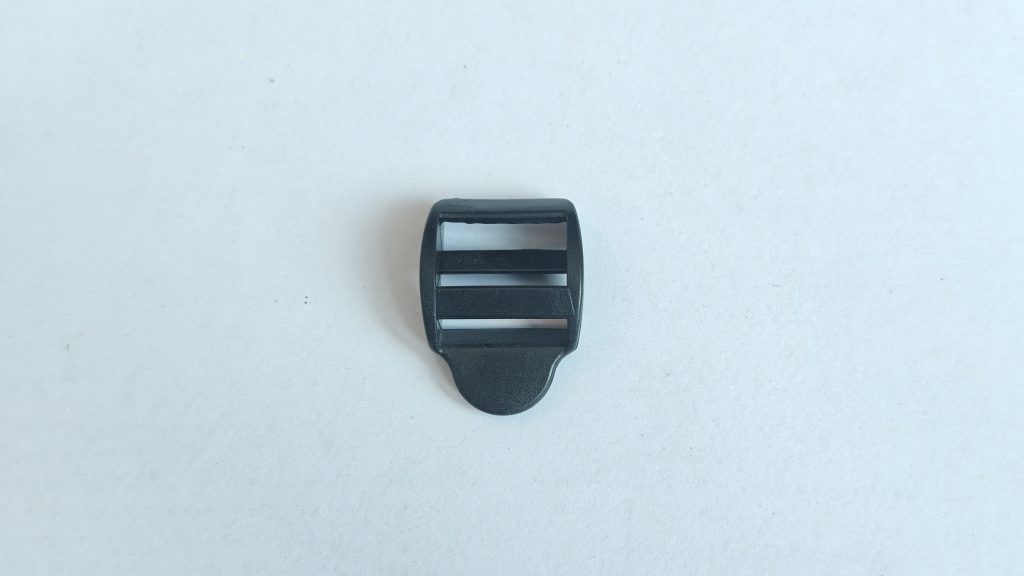
The ladder buckle (also commonly called a slider buckle or ladder lock) is one of the most frequently used adjustment buckles for compression straps. Its body is provided with webbing slots and a crossbar; the webbing passes through the slots, loops around the crossbar and threads back, and continuous webbing-length adjustment is achieved through the friction between the webbing and the crossbar. This structure suits compression strap positions that require gradual tightening and retention of position after tightening; adjustment is made by pulling the pull tab or the webbing tail.
Different ladder buckles differ in outline and operating areas: a narrow-face waisted outline with a round-head pull tab suits positions with limited operating space; a wide-face square frame with a ribbed crossbar and a curved pull tab offers a larger gripping area. When purchasing, you can tell the supplier the width limit of the installation position and the finger operating space, and the supplier will evaluate the corresponding outline. The contact effect between the crossbar texture and the actual webbing needs to be verified on matched samples; it cannot be judged from the buckle body's appearance alone.
Regarding materials, ladder buckle products can be evaluated for thermoplastic materials such as POM or PA based on crossbar rigidity, molded appearance and service environment; the specific grade, color and surface effect are subject to project confirmation.
Boundary statement
This article only discusses the types of compression strap buckles and key points for purchasing communication; it does not cover the load values, weather resistance ratings or webbing routing design of specific buckles. The stitching position of a compression strap on a bag, the webbing material and the way the buckle bears load vary with the bag structure and must be confirmed with physical samples; the performance of the entire compression strap cannot be inferred directly from the buckle's appearance.
Frequently Asked Questions
What buckle to look at when quick opening and closing or two-end adjustment is required
If the compression strap needs to be opened and fastened frequently, or if you want to release and tighten it with one hand, consider a side-release buckle; if both ends of the strap need length adjustment, look at a dual-adjustment structure.
Side-release buckles are widely used in backpacks, sports gear and soft luggage, featuring one-hand release and adjustment, with an anti-release design to prevent accidental opening. For compression straps, side-release buckles are better suited to external attachment straps that need to be opened and closed quickly or to positions where the entire strap must be removed; if you are only tightening the bag body in daily use, a ladder-lock style continuously adjustable buckle is usually more direct.
Dual-adjustment buckles have adjustment structures on both sides of the buckle body, allowing each end of the webbing to be tightened or loosened separately, making them suitable for compression straps with a wide length range that need adjustment from both ends. Some dual-adjustment structures also incorporate a ladder-lock anti-slip design for quick adjustment on the move. Whether to choose this type of structure depends on how often it is operated and whether both ends of the strap need independent adjustment.
How webbing buckles and threading fittings are used in strap-end management and external attachment
If the compression strap also needs to handle external attachment or strap-end management in addition to tightening the bag body, consider webbing-buckle type threading fittings: they have a webbing-threading section and a multi-hole face, and are combined with small hole-and-slot fittings on the other end of the webbing for webbing connection, fastening and strap-end management.
The installation path and fastening method of this type of combined structure need to be confirmed on a project basis; the combination of fasteners and webbing shown in the photos does not represent the fixed scope of supply. If you wish to reattach webbing later or reduce reliance on sewing, you can ask the supplier whether a reattachable structure is available; the split design of side-release buckles includes structures that help refit the buckle onto webbing without sewing, which can serve as a direction for discussion.
Webbing tail management can also be accomplished with the multi-slot face or the threading section of a webbing buckle, but the webbing thickness, the number of rethreaded layers, and the webbing tail accessories need to be confirmed together to avoid a mismatch between buckle and webbing.
Information to specify before requesting a quote
At a minimum, specify the webbing width and thickness, the strap length range that needs adjustment, the fastening method after tightening, the operating direction, whether adjustment is single-ended or double-ended, and the operating environment. This information determines the buckle's webbing slot dimensions, adjustment travel, and structural form, and also affects whether the supplier can directly provide an evaluable solution.
If the compression strap needs to be opened and closed frequently, also specify the opening/closing frequency and whether it will be operated while wearing gloves; if external attachment is involved, specify the weight range and attachment position of the attached item. The operating environment, such as sun exposure, moisture, or low temperature, will influence the direction of material evaluation, but the specific material grade is subject to confirmation based on samples and matching requirements.
Finally, the fit of the buckle body with the webbing, the adjustment feel, and the connection result are subject to confirmation with matching samples; the clearances and connection fit must be confirmed using the actual webbing and other mating parts. Sampling with the actual webbing is a common practice for reducing subsequent mismatches.