











Polyamide (PA, commonly called nylon) is a class of semi-crystalline thermoplastic engineering plastics, and its strength, toughness and wear resistance are the reasons it is repeatedly mentioned in buckles and accessories. However, "PA" is only a broad material category; the final performance of a buckle depends on the specific grade and modification state, so inquiries should be tied to the grade and sample confirmation.
What material is PA (polyamide/nylon)?
Polyamide is what is commonly called nylon, a class of semi-crystalline thermoplastics, with grades often denoted by numbers, such as PA6, PA66, PA12; the numbers relate to the molecular structure, and different structure types have different properties. The most common polyamides include PA6, PA66 and others, among which PA66 offers a relatively balanced combination of performance and cost.
For procurement customers, the key implication is this: although all are "PA/nylon," different grades differ in mechanical performance and moisture absorption, so the final performance of a buckle cannot be judged by the broad material category alone; quotations and confirmations must be tied to the specific material name and grade.
Which PA characteristics are typically considered when selecting materials for buckles and accessories
The characteristics often cited for PA include mechanical strength and rigidity, toughness and impact resistance, wear resistance and low friction, heat resistance, and resistance to chemicals and oils. These are the reasons polyamide is used as an engineering plastic for structural parts and sliding parts, and also the reason luggage buckles list it as one of the candidate thermoplastic materials.
For a specific buckle, the above performance depends on the grade and modification: unreinforced PA6 and PA66 each have their own emphasis in toughness and rigidity, and performance changes again after reinforcement or filling. These characteristics are therefore suitable as a starting point for material selection direction, not as a finished-product commitment for any particular buckle.
What is the difference between unreinforced, glass-fiber-reinforced, and mineral-reinforced
Common supply forms of polyamide include unreinforced, glass fiber reinforced, and mineral reinforced grades. Reinforcement is typically used to improve stiffness and strength, while mineral-filled grades are often associated with dimensional stability and low warpage; at the same time, reinforcement may also affect toughness, appearance, and dimensional behavior.
When requesting a quote, it is recommended to confirm three points directly: the specific grade, whether it is reinforced and the reinforcement type, and the color and surface requirements. Switching the same buckle structure to a different modification state may change the feel and appearance, and the final confirmation shall be based on the sample part.
Boundary notes for product examples
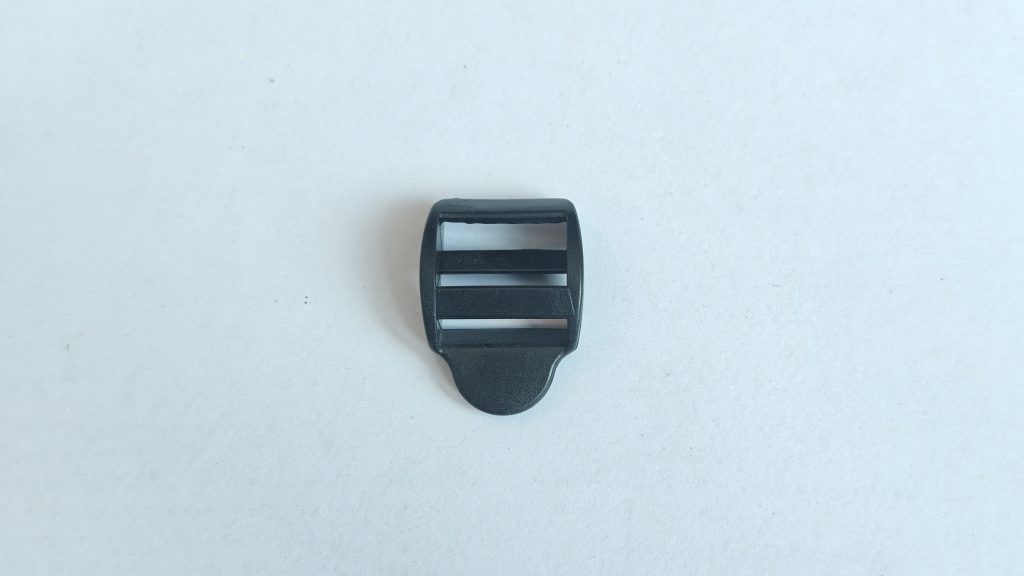
The body of the rectangular buckle is provided with multiple webbing slots and two crossbars, and its lower end is connected to a round-head pull tab, used for strap length adjustment on backpack shoulder straps, luggage compression straps, and similar positions; the D-ring is a closed D-shaped profile, the webbing can be looped around the webbing edge and folded back for fixation, and the curved area can be paired with a suitably sized hook, used for luggage webbing connection and shoulder strap hook pairing.
The above buckles can be evaluated with thermoplastic materials such as POM/PA according to rigidity and the usage environment, but the product images are only examples of appearance and application and do not mean that this model actually uses PA; whether PA is selected and the specific grade shall be subject to project sampling and the confirmed part.
Frequently Asked Questions
What PA moisture absorption means for buckle dimensions
PA has a certain degree of moisture absorption, so its dimensional stability is weaker than that of some other engineering plastics; the degree of absorption also varies between grades and affects the dimensional stability of the finished part. For buckles, this means that mating areas such as webbing slots and loop inner holes should be confirmed at the prototype stage in combination with the actual service environment, rather than judging from drawing dimensions alone.
During sampling, it is recommended to thread and fasten the buckle with actual webbing to check the adjustment feel after threading and re-threading, and to inform the supplier of the temperature, humidity and chemical contact conditions of the service environment as material evaluation conditions.
How to specify requirements when requesting quotes for ladder-lock buckles and D-rings
First state the application and load mode in the inquiry: whether it is for shoulder strap length adjustment or for connection and attachment, and whether it bears tensile force, friction or repeated operation; then describe the service temperature and humidity, whether it contacts chemicals, color and surface requirements, and whether flame retardancy or weather resistance is required. This information determines how the supplier evaluates the part among thermoplastic materials such as POM/PA.
Please also provide the webbing width, thickness, and number of threading passes, as the clearance and connection fit need to be confirmed with the actual webbing and other mating components. PA's hygroscopicity may affect dimensional stability; it is recommended to use samples and approved parts as the final basis rather than placing an order based on the material name alone.