










A jacket cuff commonly uses a small plastic part with hook teeth together with a loop face to adjust tightness; this is the injection-molded hook-face pull tab. This article explains its structural form, the differences between it and textile hook tape hook-and-loop fasteners in terms of hook tooth construction, and the mating and installation issues that need to be confirmed before requesting a quotation.
What form does an injection-molded hook-face pull tab take?
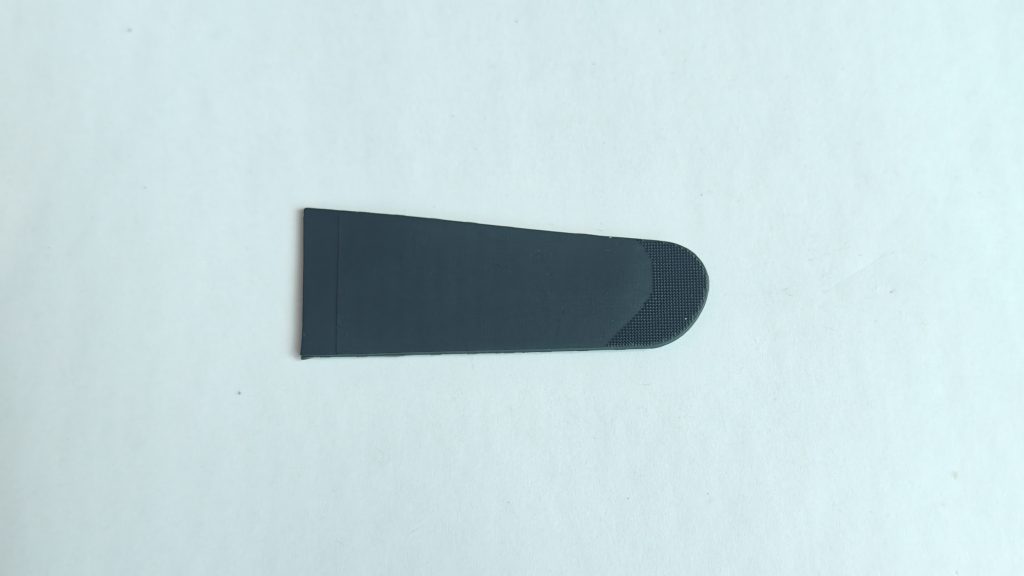
The injection-molded hook-face pull tab used on jacket cuffs consists mainly of a plastic pull tab, commonly in a long, round-headed profile: the front face is flat and can be left as a pull or logo area; the back face carries an array of hook teeth; one end has a straight, flat fastening area for attaching to the cuff. It works together with the loop face on the cuff, pressing to engage and peeling apart to release; different engagement positions correspond to different cuff circumferences, thereby providing tension adjustment.
Different styles vary on this basic structure. For example, some styles add an oval pull opening on the front for easy hooking and pulling; others feature letter markings on the front. These are differences in appearance and the pull area, while the basic approach of the hook tooth array on the back and the fixing end remains the same.
What is the difference from sewn or adhesive-backed hook-and-loop fasteners?
Taking the listed textile hook-and-loop product information as an example, this type of hook surface is mostly made of polyester or nylon, commonly in sewn or adhesive-backed form; it is soft with good conformability, suitable for applications requiring comfort or skin contact.
Injection-molded hook surfaces are another approach: the hook teeth are formed in plastic and can be molded directly onto plastic parts during integral injection molding. The integrally injection-molded hook tooth solution described in the information eliminates adhesives, the position of the hook tooth area is determined by the part itself, the color can match the main body, and the shape of the hook tooth area can vary considerably by design. However, this describes only that specific technical solution; there are also injection-molded plastic hook tapes connected by bonding or welding, and the products on this site also clearly state that the pull tab main body and the hook surface can be selected as integrally molded or combined according to the structural design. Therefore, whether the hook teeth are integral with the part must be confirmed against the drawings and samples of the specific product, and the characteristics of integral injection molding must not be applied to all injection-molded hook surfaces.
For purchasing customers, the main difference lies in whether the hook teeth are formed together with the plastic part or attached separately as a textile hook tape. With integrally injection-molded hook teeth, there is no adhesive layer, and the step of attaching the hook tape is also eliminated; but in either form, the fixing end of the pull tab still requires a sewn or bonded solution evaluated according to the fabric, and it is not the case that no subsequent process is needed once installed. Injection-molded parts have a plastic main body, and the bending feel and edge touch must be confirmed against samples; they must not be assumed to be the same as textile hook tapes.
How to confirm the matching loop surface and fastening method
The hook surface must be combined with a compatible loop surface to work; the two are a matched pair, so the hook surface alone cannot be confirmed. The choice of hook tooth shape depends on the application and on the properties of the mating woven, nonwoven or loop material, and the loop type and surface structure affect the mating performance. Therefore, when requesting a quotation, provide the loop surface information for the cuff as well, or take the sample piece confirmed by both parties as the reference.
How the fastening end is attached to the cuff must be evaluated according to the fabric. The direction given in the product information is: for the flat end, options such as sewing or bonding can be evaluated; which one to choose must be determined in conjunction with the fabric type, mounting position and garment construction method, and verified with a sample piece. The bonding area and pull-tab length are related to the cuff pattern, and the force direction must also be confirmed on the actual garment; it should not be judged from the pull tab alone.
Regarding materials, the injection-molded hook surface can be evaluated in thermoplastic materials such as PA and PP according to the structure; if the pull-tab body has requirements for bending and hand feel, the corresponding plastic or TPU and TPE can be evaluated. The above is a range of options, not a fixed configuration; the actual material selection must be determined in conjunction with the structural design and sample results, and the appearance shown in the images does not represent a confirmed specific material.
Scope of application statement
This article discusses an injection-molded hook-face pull tab for cuff adjustment on shell jackets and outdoor outerwear, and it also applies to similar scenarios such as adjustment points on activewear and webbing on bags and luggage. The specific engagement strength, cycle life, and post-wash performance must be verified against the actual materials, mating loop face, and garment conditions; this article does not provide a uniform numerical conclusion.
Frequently Asked Questions
Injection-molded hook face or sewn-on hook tape for cuff pull tabs
Each has its own suitable scenarios, depending on which side you value more: textile hook tape is soft and suited to apparel and skin-contact situations; integrally molded hook teeth can eliminate the adhesive layer and the step of attaching hook tape, and the hook-teeth area stays positionally stable. If the cuff requires large-area soft engagement, textile hook tape is more suitable; if you want the hook teeth formed together with the part and one attachment step removed, an injection-molded solution can be evaluated. Ultimately, however, you still need to combine opening and closing frequency, washing conditions, and cuff loads, and verify with samples; you cannot judge directly from "injection-molded" or "sewn" alone which one is more durable.
What information needs to be provided before requesting a quote
The core is to clearly state the garment usage conditions together with the part requirements. The suggested checklist includes: cuff pattern and pull tab mounting position; pull tab shape, length, thickness, and form of the pull portion (straight, oval opening, or other); size and position of the hook-teeth coverage area; shape of the fastening end and the expected fastening method; required color and front-side marking content; type of mating loop face; expected opening and closing frequency and washing conditions; quantity and delivery date.
It should also be made clear which information remains to be determined. Images can only reflect the external contour; they cannot be used to determine the specific material, hook tooth parameters, or whether the hook teeth are integrally molded with the main body. The material, hook tooth shape, and mating loop surface all need to be confirmed during the evaluation or sampling stage. Suppliers can typically support evaluation from drawings or samples, sampling, and mass production, with dimensions, materials, colors, and markings customizable per project, subject to final confirmation of the approved sample.