












Detachable shoulder straps and bag attachment hardware often reveal fit issues during the sampling stage: the hook opening will not fit over the D-ring, the orientation is awkward once installed, and it is unclear whether the hook gate is reliable under load. This article examines, from a procurement perspective, the opening and closing structures of snap hooks and spring hooks, their compatibility with plastic D-rings, and the information that should be aligned before requesting a quote.
What connection role do snap hooks and spring hooks play on bags and luggage?
Snap hook plastic parts are used at connection points that need repeated assembly and disassembly. The snaphook is one of the more common traditional connectors, most often used for detachable shoulder straps; it is lightweight, looks good, and also emphasizes weather resistance and durability. The spring snaphook, by contrast, uses an integrally molded spring to provide smooth spring-open and spring-back action, and its appearance positioning suits high-quality bags and suitcases.
From a procurement perspective, the function of this type of part is to turn the webbing end and the ring end into a detachable connection, and selection questions center on three points: whether the hook opening can fit over the matching ring, whether the load direction runs along the hook body, and whether it will accidentally come loose under load once installed. The specific method of securing the webbing end to the snap hook must be confirmed on the specific snap hook product page or with a sample; it should not be inferred from appearance alone.
What are the two common types of opening and closing structures?
One type is the interlocking hook tongue and hook body structure. The documentation states that this interlocking hook and tongue design is intended to reduce the possibility of the tongue accidentally coming loose under load; snap hooks in the same series with a rotating function also use this structure. Whether it suits your fixed-direction connection still needs to be confirmed with samples and the actual load direction.
Another type is the integrally molded spring structure. The smooth opening and spring-back of the spring hook are provided by an integrally molded spring rather than a separate spring part. When communicating with suppliers, you can therefore ask whether the hook tongue springs back smoothly and whether the opening is easy to operate; this feel is best confirmed by trying a sample.
What information should be written clearly at once for materials and inquiries
The specific materials of the eyelet buckle and spring hook are subject to confirmation by sample and project. The material selection approach for the matching D-ring can serve as a reference: thermoplastic materials such as POM and PA can be evaluated based on ring rigidity, molded appearance and service environment; the specific grade, surface effect and color are customized per project and confirmed by sample. For the hook body material, the same questions can be used to request samples and confirmation results from the supplier.
It is recommended to include everything in the inquiry at once: the hook's opening size and openable inner width, the matching D-ring's inner hole and ring body cross-section, the webbing width and thickness, the number of threading layers, the load direction, and the desired material and color. Among these, the D-ring inner hole, ring body cross-section and webbing-passing edge curvature can be customized per project, and the webbing fit and connection retention effect are confirmed by the matching sample; for the hook body opening size, please confirm with the specific eyelet buckle product page or sample. Listing these items clearly makes it easier to obtain a usable solution than sending only a reference image.
If the project also needs to control edge wear on the webbing or leather, the appearance and edge requirements can be raised together in the inquiry. The information mentions that smooth edges help avoid snagging or tearing fabric and leather, but this statement refers to external products, and the specific structural features need to be checked against the selected sample.
Scope of application statement
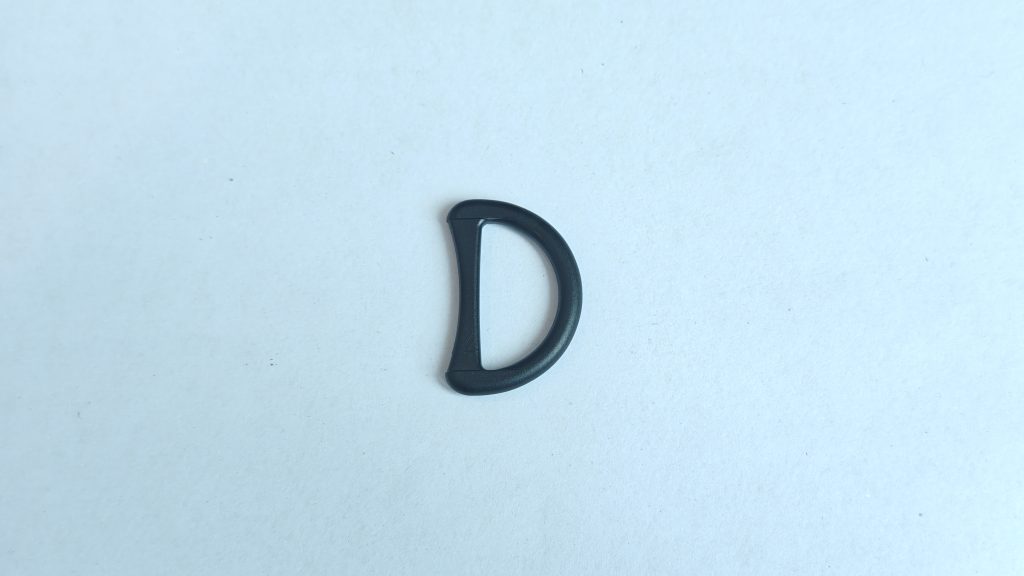
This article mainly discusses detachable connections on bag shoulder straps and bags, as well as the matching plastic D-rings; the coverage of apparel applications in this article is insufficient and requires separate confirmation. The D-ring shown is an example of a matching ring body and does not represent the material of the snap hook or spring hook. Load ratings, weather resistance durations and specific test criteria shall be separately confirmed according to project requirements and with the supplier.
Frequently Asked Questions
When mating with a D-ring, which dimensions must be aligned first?
First confirm that the hook opening can fit over the ring body cross-section of the D-ring, then confirm that the D-ring inner hole can accommodate the webbing and the number of folded-back layers. The D-buckle is a D-shaped part with a closed ring body; the arc area is intended for mating with a suitably sized hook or connector, and the documentation explicitly states that the hook opening and the ring body cross-section must match; therefore, matching only the single figure of "hook opening width" is not enough—the ring body cross-section dimensions must also be included in the same comparison table.
On the webbing side, look at the threading edge: the webbing passes around the threading edge and is folded back and secured; the ring body inner hole and the stitching method are determined by the bag structure; the suitable webbing width, thickness, number of re-threaded layers and installation position can be evaluated per project. The hole clearance and connection fit must be confirmed with the actual webbing and other matching parts; drawing dimensions cannot replace physical fitting.
Under what circumstances is an anti-rotation structure worth considering?
Check whether the attachment point needs to keep the ring body orientation stable. Some hook bodies have specially shaped designs to prevent the ring body from rotating within the webbing loop. If your attachment point easily lets the ring body flip over and affect appearance or the hanging direction, consider hooks with an anti-rotation design first; if the attachment point already allows free rotation, there is no need to add constraint for this.
Whether it applies also depends on the shape of the matching D-ring and the webbing routing. D-rings come with different webbing-threading edges and arc contour designs; for the natural orientation and tendency to flip after being combined with the hook body, it is recommended to assemble matching samples and observe to confirm, as it is difficult to judge from appearance drawings alone.