











Both are ladder-lock pull tabs, but the triangular-mark pull tab at the lower end and the gradually narrowing long-tail pull tab each take a different approach to outline and branding display. Starting from pull-tab shape, this article helps purchasing customers clearly explain style preferences, LOGO artwork, and webbing compatibility in one go, reducing repeated sampling rounds.
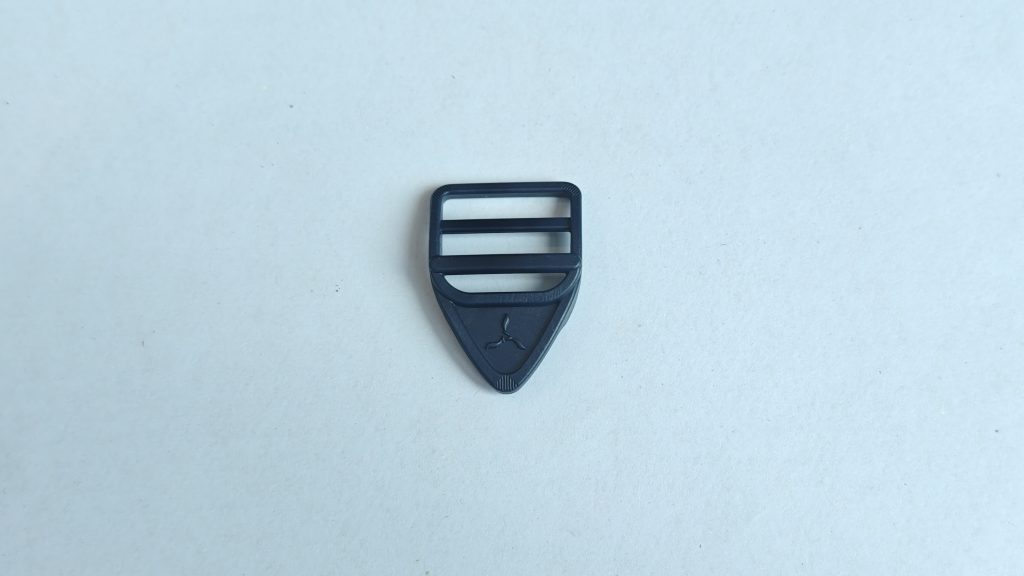
How can the two ladder-lock slider shapes be distinguished by appearance?
The upper part of the ladder-lock body is provided with multiple webbing slots and two crossbars; the webbing is threaded back through the webbing slots and crossbars to adjust the length of the shoulder strap or fixing strap, while the lower slider serves as the operating part. The differences are concentrated in the contour of the lower end: on the triangular-mark slider, the lower part of the body extends into a triangular-contour slider, with an area left on its face for marking; on the long-tail slider, the upper part of the body is a chamfered outer frame, and the lower part connects to a gradually narrowing long-tail slider, whose face likewise carries a marking area. The former looks more geometric, with a wider lower end; the latter narrows progressively downward from the body, giving it a more slender line.
Both retain the basic structure of "adjustment at the top, slider at the bottom", and the functional positions for webbing threading and adjustment are identical; the visual differences come mainly from the slider shape rather than from any division of function in the body. When selecting, first place the two samples side by side and compare their contours and proportions, then decide whether they harmonize with the overall style of the bag.
How should the face marking area be communicated?
The faces of both sliders carry a marking area where custom LOGO artwork can be applied, which is one of the customization options for the ladder lock. When requesting a quotation, provide vector or clear artwork and state the desired position of the mark on the slider face and its approximate footprint, so that the supplier can assess the printable area in conjunction with the selected slider contour.
The width of the pull tab affects the area available for branding: the wide pull tab product example notes that a wide pull tab is easy for fingers to slip into and can carry a wider logo. This suggests that the wider the pull tab, the more room is generally available for branding; however, that example is a different adjustable buckle product, so it cannot be used to infer the specific material, performance, or printable dimensions of the triangular-logo pull tab or the long-tail pull tab. Actual details are confirmed by the sample and prototype of the selected style.
Use Scenarios and Selection Boundaries
Both types of ladder-lock buckles can be used for strap length adjustment and management on backpack shoulder straps, luggage compression straps, storage pouch securing straps, and similar locations. The specific installation method must be confirmed based on the webbing routing, the fixed end, and the usage conditions. The triangular-logo pull tab can be designed around the operating position, while the long-tail pull tab is paired with a chamfered outer frame. This article discusses only the appearance and communication differences arising from pull tab shape; it does not address conclusions about the buckle body's load-bearing capacity or adjustment strength, which must be verified with samples and actual usage conditions.
Frequently Asked Questions
As the pull tab is the operating part, how can feel be confirmed during procurement?
Both shapes use the lower pull tab as the operating part, but the available information does not provide a quantified difference in grip contact area, so it is not possible to judge directly from shape which one is easier to operate. A practical approach is to thread the target webbing through the sample, install it at the bag's mounting position with the actual number of rethreaded layers, and pull it by hand to feel the contact surface and force direction, confirming whether adjustment is smooth and whether it remains stable after rethreading.
When confirming, also check whether the webbing passes through smoothly, whether the edges of the opening affect use, and whether the position relationship between the pull tab direction and the fixed end matches the bag structure. These all belong to the matching confirmation content; it is recommended to evaluate them together with the actual webbing and matching components, rather than looking at a single part alone.
What information needs to be provided when making an inquiry?
Provide the style and information all at once first, and quotation and sampling will be faster. It is recommended to state clearly in the inquiry form: pull tab shape preference (triangular logo pull tab or tapered long-tail pull tab), LOGO artwork and logo position, buckle body size and color, material orientation, as well as the width, thickness, number of re-threading layers, and installation position of the compatible webbing.
For materials, thermoplastic materials such as POM/PA can be evaluated based on the rigidity of the crossbar or ring body, molded appearance, and use environment, but the specific grade, surface effect, and color need to be customized according to the project and confirmed with samples and matching requirements. Dimensions, materials, colors, and logos can all be customized according to the project, with support for evaluation based on drawings and samples, sampling, and mass supply; the openings and connection fit must be confirmed together with the actual webbing and other matching components. If safety-related uses such as personal flotation devices or baby carriers are involved, applicability should be discussed separately with the supplier.