











When adding zipper pull cords to the placket or pocket zippers of outdoor apparel, customers often have to decide between two appearances: a plastic (TPU/TPE) soft grip, or a plastic grip with a metal end exposed beyond it. The interface logic of the two is similar; the differences lie in hand feel, visual accent, and the confirmation items that must be settled in advance when requesting a quotation. Below, based on the pull tab hole, cord loop length, gloved operation and appearance requirements, we set out the selection approach and the sampling checklist.
Define the interface first: pull-tab hole, cord loop length, and grip method
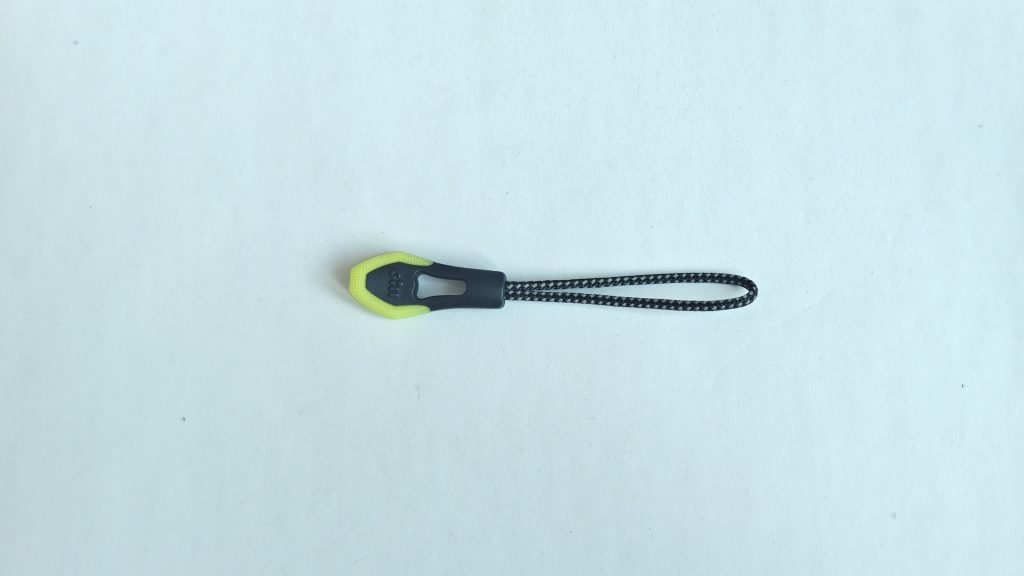
The basic structure of a zipper cord is a cord loop threaded through the zipper pull-tab hole, with the grip used to extend the pull area, making it easier to grab and to drive the zipper open and closed. So the first step is not choosing materials, but confirming three things: whether the pull-tab hole can accept the cord loop, whether the cord loop length matches the placket or pocket position, and how many fingers the user habitually uses to pinch the grip. Take the open-hole spliced zipper cord as an example: the grip end has a polygonal outline and an elongated opening, and the tail connects to a braided cord loop; the cord loop dimensions and the pull-tab hole must be confirmed against the sample.
Outdoor apparel in particular must be evaluated for gloved operation. Zipper industry literature notes that pulling a short pull tab up and down may be inconvenient for users wearing gloves, so larger and longer pull-tab options can be offered; the actual feel must still be verified through samples. During procurement, "can it be pinched and pulled smoothly while wearing thick gloves" can be written into the sampling requirements rather than judged from drawings alone.
Soft plastic grip solution: lightweight integrated feel and color options
The open-hole spliced zipper cord follows the approach of a plastic grip paired with a braided cord loop: the grip and cord loop may be connected by overmolding or assembly fixing, and whether they are integrally molded depends on the specific structure and sample. In appearance, the emphasis is on lightweight design and color schemes, making it suitable for positions requiring clear style coordination, such as the placket and pocket zippers of shell jackets and sportswear. For the grip, thermoplastic elastomers such as TPU / TPE can be evaluated, with material selection based on hardness, feel, and molding requirements; for the braided cord, polyester or nylon can be evaluated, and the cord body and grip should be confirmed as a matched set, with specific grades subject to project material selection and samples.
The material-side evidence must be kept within a defined scope. Some TPU data, such as the Elastollan N series, list properties including rebound resilience, elasticity, and strength; this is a general material description for that grade family and cannot be applied directly to all TPU, so the specific grade is governed by material selection. Regarding TPE, supplier data mention that in zipper pull-tab applications it can combine abrasion resistance, a smooth tactile feel, and multi-shape and multi-color design; these are likewise general material properties and do not represent the finished performance of any specific grip model.
Frequently Asked Questions
What additional items must be confirmed for the metal end-tip option?
Put simply: confirm one more link — the material, surface treatment, color, and fastening method of the metal end tip itself. A typical construction is a braided cord loop connected to a cylindrical grip, with an exposed metal end tip visible at the other end; for such products, the metal end tip must be confirmed together with the plastic grip, the cord connection, the pull-tab hole fit, and the overall appearance through sampling, and the grip alone must not be the only item examined.
When requesting a quote, it is advisable to first state the desired color and appearance effect and whether the end tip needs to match the slider or other hardware, and then let the supplier propose the available materials and surface treatments before deciding, rather than specifying a particular metal grade or treatment process outright from the start. The assembly of the metal end tip with the cylindrical grip, the cord fastening, and the zipper slider connection scheme are evaluated by structure, and the final firmness and open-close feel are subject to sample inspection.
How should the use environment be communicated to the supplier?
This must be clarified, because it determines what to test during sampling. At a minimum, specify: whether gloves are worn frequently, whether the zipper is on the placket, a pocket, or a cuff, the expected pull frequency, and whether it is exposed to rain, snow, mud, and sand. The specification selection for zippers used in outdoor jackets is related to the fabric and garment type; for example, lighter or children's jackets may use smaller zipper sizes, while heavy fabrics use larger sizes; the specific specifications are subject to confirmation based on the zipper supplier's documentation or the project.
The cleaning and maintenance method should also be specified in advance, for example, full-garment washing, spot wiping, or dry cleaning. For the metal end-tab option, attention must be paid to the appearance of the metal part after cleaning, while for the soft rubber grip option, attention is paid to whether the color scheme and surface texture readily trap dirt. These are the usage conditions that the purchaser should communicate; the specific durability performance is confirmed through samples and with the supplier, and it is not recommended to write them as acceptance criteria unilaterally at the inquiry stage.
Inquiry checklist: state the appearance intent and acceptance requirements clearly
It is recommended to list them in this order: usage environment (outdoor or daily, whether gloves are worn, pull frequency); cleaning and maintenance method; expected appearance (integral soft rubber feel or metal accents); zipper pull-tab hole size and attachment method; cord loop length and cord diameter; grip profile and opening size; method of confirming end-tab material and color; acceptance requirements (attachment strength, pull-tab hole fit, color difference subject to the confirmed sample). Also provide product images, drawings, dimensions, and quantity requirements to facilitate the supplier's evaluation.
In wording, leave room for sampling: for materials, write "TPU or TPE, one to be evaluated"; for metal end tabs, write "material and surface treatment to be confirmed", avoiding hard-coding material grades or unconfirmed metal treatments. TPU and the thermoplastic elastomer compounds commonly abbreviated as TPE belong to different material systems (TPU itself also falls within the thermoplastic elastomer category), and the hand feel will vary with formulation, hardness, and structure; it is recommended to request from the supplier comparison samples of the same structure in different materials before deciding. The above recommendations are based on general knowledge of material classification and product structure; specific performance is subject to the selected material samples.