











For children's apparel and children's bags exported to the US, accessories are small but may still fall under the CPSIA children's product safety framework. Before requesting quotes, buyers need to first determine whether a product qualifies as a children's product, then clarify with suppliers the scope of materials, testing, and compliance documentation, rather than assuming the supplier already has reports or certifications.
First, determine whether the accessory enters the CPSIA context along with a children's product
The main objectives of the CPSIA (Consumer Product Safety Improvement Act of 2008) include strengthening safety requirements for children's products. Accessories themselves are usually not end consumer products, but when items such as buttons and zippers are used in children's products like children's apparel and children's bags, they fall within the scope of the safety assessment of the final product. Procurement should not look only at the accessory name; it must first confirm the final use and the applicable age group.
For example, buttons can be used in different scenarios such as shirts, knitwear, children's apparel and outerwear, bags, and home textiles. The same four-hole or two-hole button faces different compliance concerns when used on adult apparel versus children's apparel. When requesting a quote, you should first explain the final product type and the location of use to the supplier.
What hazardous substance restrictions does the CPSIA generally focus on?
Based on public information from the accessory supply side, the CPSIA's main concerns for accessories include lead content (surface coatings and substrates) and phthalate restrictions. Some fastener suppliers use in-house testing to confirm that their products meet these requirements, but exceptions (such as specific waterproof zippers, styles containing PVC materials, or styles containing lead crystal/rhinestones) need to be confirmed separately.
This means that when requesting quotations, procurement should not simply ask whether a product is "CPSIA compliant" but should specify the material type, surface treatment (such as spray coating, electroplating, or hot stamping), and color, because these factors may affect the risk of hazardous substances. Plastic buttons can be made of POM, PP, ABS, or resin, and the surface treatment method also needs to be specified in the project.
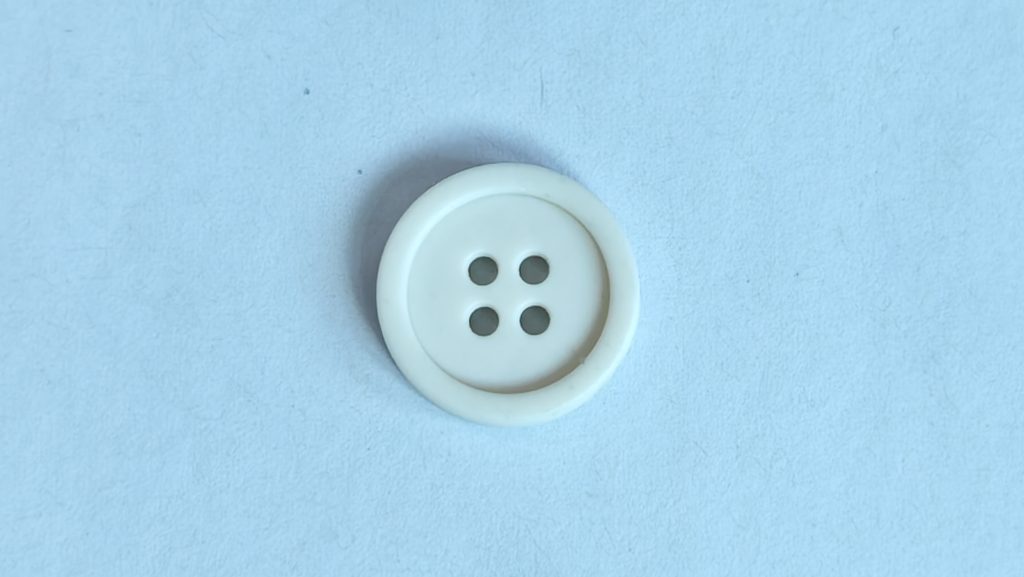
Use actual button photos to understand where trims are positioned on children's clothing and bags
Taking four-hole and two-hole buttons as examples, buttons are commonly used on garment plackets, cuffs, and necklines as well as for fastening and decoration on bags. For buttons used on children's clothing, rounded corners and wide-edge shapes can be considered to reduce the scratching sensation; for buttons used on bags, surface effects such as matte or glossy can be selected. These appearance and structural choices need to be confirmed in conjunction with the intended use scenario of the final product.
During sample confirmation, attention should be paid to dimensions, color, surface effect, and fastening usage requirements. Specific materials and compliance documents need to be confirmed with the supplier on a project basis. The actual product photos only indicate where the buttons are applied and do not indicate that the model has passed CPSIA testing.
Boundary statement
This article only explains the general points of concern under CPSIA and key points for quotation communication based on public information from the trims supply side. It does not constitute legal advice, nor does it mean that any supplier has obtained CPSIA certification. Specific test standards, limits, and reporting requirements should be subject to the current rules of the U.S. Consumer Product Safety Commission (CPSC), buyer contracts, and platform policies.
Frequently Asked Questions
Small parts and torque testing: Keep regulatory requirements separate from additional customer requirements
Whether children's apparel accessories need small parts testing and torque testing depends on specific regulations and customer requirements and cannot be generalized. Publicly available information shows that children's apparel may be exempt from ASTM small parts testing, but suppliers may conduct internal testing to ASTM standards on their own initiative to mitigate choking hazards; torque testing is also not a mandatory CPSIA requirement, and some suppliers proactively perform it to ASTM standards.
Therefore, when requesting a quotation, "regulatory mandatory requirements" and "additional customer or platform requirements" should be listed separately. If the buyer or e-commerce platform requires small parts testing or torque testing reports, the testing standards and report format should be stated directly to the supplier, rather than assuming that accessories meet these additional requirements by default.
What information to clarify before requesting a quotation
When requesting a quotation, at a minimum the following should be explained to the supplier: the final product type (children's apparel or children's bags) and the area of use, the child's age group, the target market being the United States, the accessory material and surface treatment/color, the order volume, and the testing standards and report format required by the customer or platform. This information determines how the supplier assesses the scope of materials and compliance documentation.
If only the accessory name and quantity are provided, suppliers find it difficult to judge whether children's product requirements are involved, and cannot confirm which models and colors the test report should cover. Writing the use scenario and compliance expectations into the inquiry sheet in advance can reduce subsequent back-and-forth.
How to verify the compliance statements or test reports provided by suppliers
After receiving a supplier's CPSIA compliance statement or test report, you should verify the product models, colors, surface finishes, batches, report validity period and issuing organization covered by the report, and confirm that the samples corresponding to the report are consistent with the production samples. Do not assume that the supplier already has a report or has already passed certification, and do not directly treat the supplier's compliance statement as compliance proof for your own product.
Some suppliers' compliance statements explicitly exclude specific products (such as certain waterproof zippers, styles containing PVC materials, or styles containing lead crystal/rhinestones). Procurement should check its own accessory specifications item by item to confirm whether they fall within the exclusion scope.