












Two questions come up most often when sourcing the spring cord locks commonly found on hood drawcords, hem drawstrings, and bag closures: how does it release with a press and grip again when you let go? And which parameters should be specified in an RFQ so the cord and the lock body match on the first try? This article explains them one by one by application, operating method, appearance type, and confirmation items.
Where is the spring cord lock installed, and what does it do?
A spring cord lock is a small accessory installed on drawstrings to organize and adjust cord length, so that hood cords, hem cords, bag openings, or bag closures stay at the desired position. Common matching locations include jacket hood cords, hem drawstrings, and cord channels on bags and storage pouches; when selecting, the cord passage opening, the attachment point, and the space for pressing operation must all match the installation location.
In supplier catalogs, this type of accessory is often listed under applications such as apparel and sporting goods, and some products state they can be used in scenarios with outdoor exposure and temperature variations. Weathering performance depends on the specific grade and the actual service environment; you cannot assume that a particular cord lock body is suitable for all climatic conditions just because it is labeled "outdoor usable"—confirmed samples and material specifications should be taken as the basis.
How does press-to-tighten operation work?
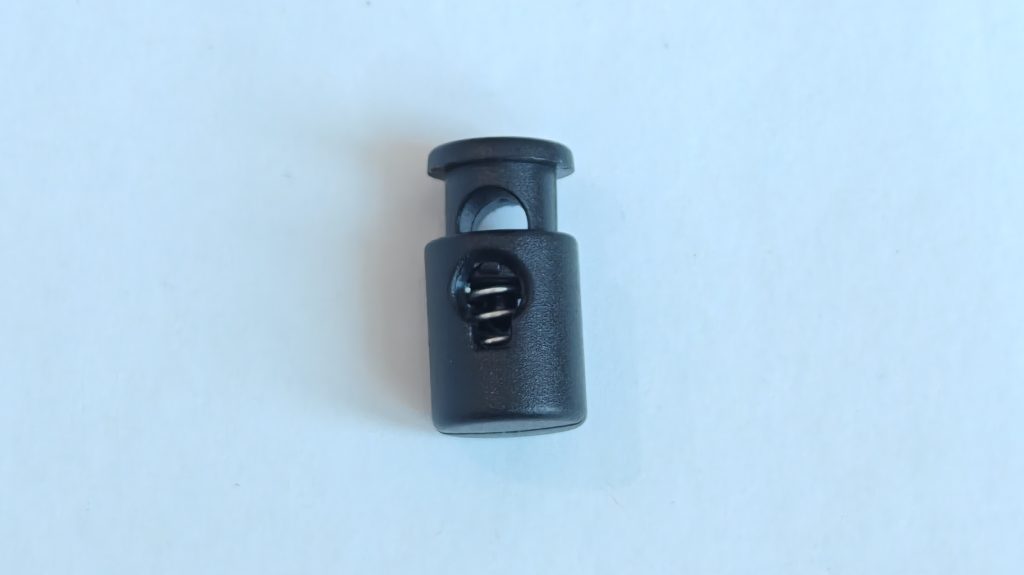
The common structure has a spring installed inside the cord lock body to grip the cord: press the movable push button, the gripping part inside the hole releases, and the cord can be pushed or pulled to adjust length; after releasing the push button, the cord is gripped by spring return, keeping the cord length at the adjusted position. The cord routing path and the actual adjustment effect must be confirmed with the specific cord.
Different suppliers differ in operational details: some are designed for one-way cord locking, where the cord is locked in only one direction for easier operation; some have the cord holes pre-aligned, so that after threading the cord, pressing releases the lock and a spring clamp holds it; a few styles provide tie-down points for one-handed adjustment. These differences must be confirmed against the specific model and sample, and cannot be generalized.
What are the common appearance styles?
The most basic form is a cylindrical cord lock body with a round push button, with cord holes on the side through which the metal spring is visible. The cylinder outer diameter, the button edge, and the side hole openings can all be used as customization evaluation items.
Besides the cylindrical style, oval-body styles are also available on the market, as well as downsized, lightweight styles. The specific external dimensions, button orientation, and required installation space of the oval and cylindrical styles should be confirmed according to the supplier's drawings and the actual installation space, and it is not advisable to compare volume or grip direction on your own based on appearance.
How to communicate about colors, markings, and customization
Colors, surface effects, and LOGOs should be clearly specified at the time of inquiry: artwork and color samples can be provided, and mass production should begin only after confirming the color samples and logo samples, so as to avoid color deviations or unclear logos. Customizable items that can be evaluated include the outer diameter of the barrel, the edge of the push button, the side openings, overall dimensions, opening clearance, surface effect, color, and LOGO artwork.
When communicating, it is recommended to provide product photos, drawings, cord samples, target dimensions, and quantities, based on which the supplier will evaluate structural feasibility and produce samples first. During the sampling stage, focus on whether the push button moves smoothly, whether the openings align with the cord body, and whether the position is stably maintained after release; the adjustment feel and holding effect should be verified with the actual cord and under real usage conditions.
Scope of application statement
The spring cord lock discussed in this article is used for length management and positioning adjustment of drawstrings on apparel and bags, and does not involve load-bearing or safety-related applications. If it is intended for use in parts with special safety requirements, such as personal flotation devices or baby carriers, applicability must be confirmed separately with the supplier, and local regulatory requirements must be verified.
Frequently Asked Questions
How can cord diameter and opening match be confirmed during procurement?
First confirm the cord diameter and cord cross-section, then select the cord lock body. The cord lock body grips the cord by means of a spring; if the cord is too thick, it may not pass through or adjustment may be difficult, while if the cord is too thin, the grip may be insufficient. At the time of inquiry, provide the cord diameter, cross-section shape (round cord or flat cord), and a physical cord sample, and ask the supplier to evaluate whether the hole diameter and opening clearance match according to the sample.
Also specify the cord routing path and installation method: whether the cord lock is threaded separately onto the cord, or sewn onto the garment and then adjusted via the end rings. The installation location determines the orientation of the cord ends and the available operating space; an overly tight location makes pressing and pushing/pulling awkward. During sampling, it is recommended to simulate the actual assembly before testing adjustments.
How do you choose the material for the plastic lock body?
Plastic cord locks commonly use materials such as POM (polyoxymethylene, also known as acetal). Some suppliers claim that their own POM injection-molded fasteners outperform common metal fasteners in chemical corrosion resistance; this claim applies only to that supplier's products and cannot be generalized into a general comparison of POM versus metal. DAWEI This cord lock is available in PA, POM, PP, and TPU; material selection should be evaluated based on structure and usage requirements. The chemical and weather resistance of specific grades must be confirmed in combination with the media and environment of use.
Whether the lock body and the moving parts of the same lock are made of the same material, or materials are selected separately according to structure, must be clarified during inquiry by stating the usage scenario for the supplier to evaluate. If the finished product is to undergo dry cleaning or is required to match the fabric color, this should also be communicated in advance: some cord locks can be dyed to match the fabric and support dry cleaning, but applicability is subject to the specific model's specifications.