











Tool grips, medical device handling areas, and housing seals often require both rigid support and a soft tactile feel. This article explains, from a procurement perspective, the basic meaning of overmolding, the products it suits, and the information to prepare before requesting a quote.
Basic meaning of overmolding
Overmolding is the process of injecting an additional layer of resin onto an already molded hard part, so that a single product combines the characteristics of two materials, which is difficult to achieve with a single material. The most common form is coating a hard substrate with a rubber-like soft material, usually TPE (thermoplastic elastomer), to provide a soft, friendly hand feel.
It can also be used to change or enhance the appearance of a part, for example by overmolding materials in different colors or surface effects. Therefore, overmolding is not only about "making it soft"; sometimes what the customer wants is a two-color appearance or a localized difference in texture.
On which products is hard-soft combination commonly found?
Overmolded parts have a wide range of applications, from medical devices and hand tools to toothbrushes, as well as gaskets and seals inside assemblies, overmolding materials can be found. Soft materials often provide sealing, damping, or elastic functions, while the hard portion provides structural support.
In two-component injection molding, materials are usually used in hard/soft combinations: TPE provides elastic functions, such as functional seals in housings, overmolded grips on tools or medical devices, and snap-fit elastic elements. When purchasing, you can check whether your project falls near these positions.
Practical significance for purchasing customers
Overmolding can form a good bond between different materials and eliminates the step of manually assembling materials, which is one of the main reasons it is adopted. For customers, this means one fewer assembly process and the corresponding assembly tolerance issues, but the premise is that the bonding of the soft and hard layers is carefully considered at the design stage.
Soft materials offer considerable design freedom in appearance and feel: TPE can be flexibly colored, and surface effects can also be adjusted as needed. However, the feel cannot be judged by hardness values alone; hardness is not a reliable indicator of grip slip resistance, and the final judgment should be based on the actual feel of the sample and the usage scenario.
Using an existing soft-grip product to understand appearance and feel
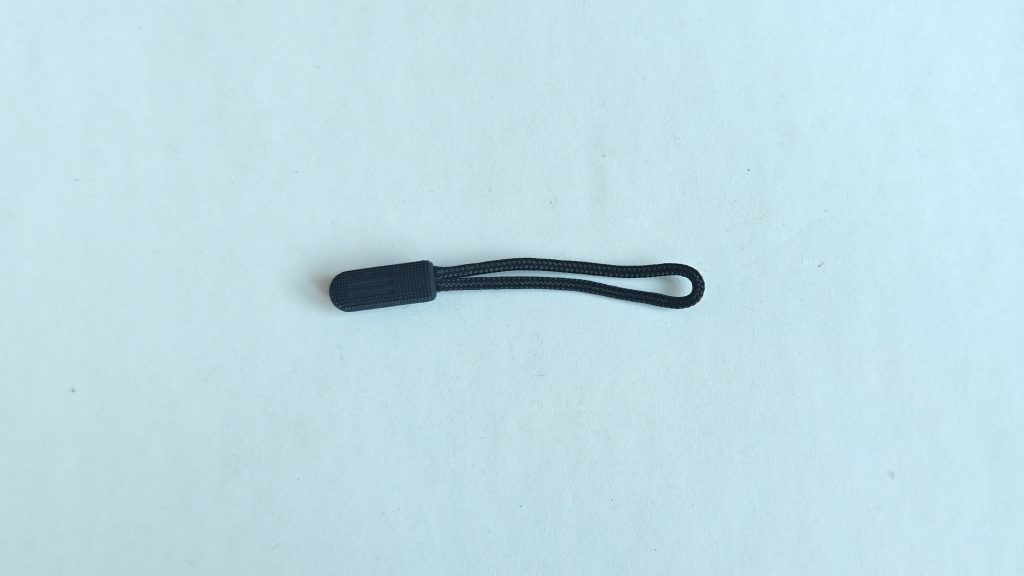
The grip on the zipper pull cord is a compact rounded rectangle with longitudinal ribs and a fine-texture area on its surface, and a braided cord loop attached at its tail; the grip extends the pull area and makes it easier to grasp. It can serve as a reference for the appearance and feel of a soft grip in terms of ribs, rounded corners and surface fine texture.
It should be noted that the grip of this product can be evaluated in thermoplastic elastomers such as TPU/TPE, with the material selected according to hardness, feel and molding requirements; the specific material grade is subject to the project material selection and samples. The image shows the grip form of this product; it does not mean that the product is a dual-material structure of a rigid body plus an overmolded layer, nor that other products use the same material.
Boundary statement
This article only explains the concept of overmolding and the key points of procurement communication. Whether the bond between the hard and soft layers is reliable, and whether the feel and appearance of the finished product meet requirements, must be judged based on the confirmed material combination and samples, and cannot be concluded from a conceptual description alone.
Frequently Asked Questions
Why bonding between hard and soft layers must be confirmed by material combination
Because adhesion depends on the specific pairing of the soft material with the rigid substrate, you cannot rely on the general term "TPE overmolding onto rigid plastic" alone. The TPE formulation must match the corresponding rigid material, and different formulations cover different ranges of bondable materials; PP with TPE is a relatively common combination, and there are also material series developed for substrates such as PA, PC, and ABS.
Adhesion can come from two mechanisms: chemical bonding at the interface between the two material layers, and mechanical bonding that depends on the interface geometry. Soft elastomers bend easily and can be pulled away from the substrate, so bond strength deserves particular attention in hard-soft combinations, and the specific performance should be confirmed according to the selected material combination and sample parts.
What information needs to be prepared before requesting a quote
At minimum, specify the material of the rigid body, whether the soft layer is to use TPU or TPE, the color, the desired feel, and the operating environment; this information determines whether the materials can be paired and how they will be evaluated afterward. Saying only "make it a bit softer" is not enough for a supplier to judge the solution.
If there are clear requirements for feel or slip resistance, it is advisable to provide a reference sample or a description of the use scenario, because hardness values do not directly represent the grip feel. Color, surface effect, and the coverage areas of the soft layer should also be stated together at the inquiry stage to reduce back-and-forth later.