










For bag hardware such as side release buckles, side-opening buckles, and ladder locks, the material options commonly listed in factory product documentation are POM and PA66 (nylon). Both materials can be used for injection-molded buckles, but publicly available material information emphasizes them differently. This article follows the practical communication sequence between purchasing and design to explain the characteristics commonly mentioned for each material and what information should be confirmed during the quoting and sampling stages.
What POM and PA are, and how they appear in buckles
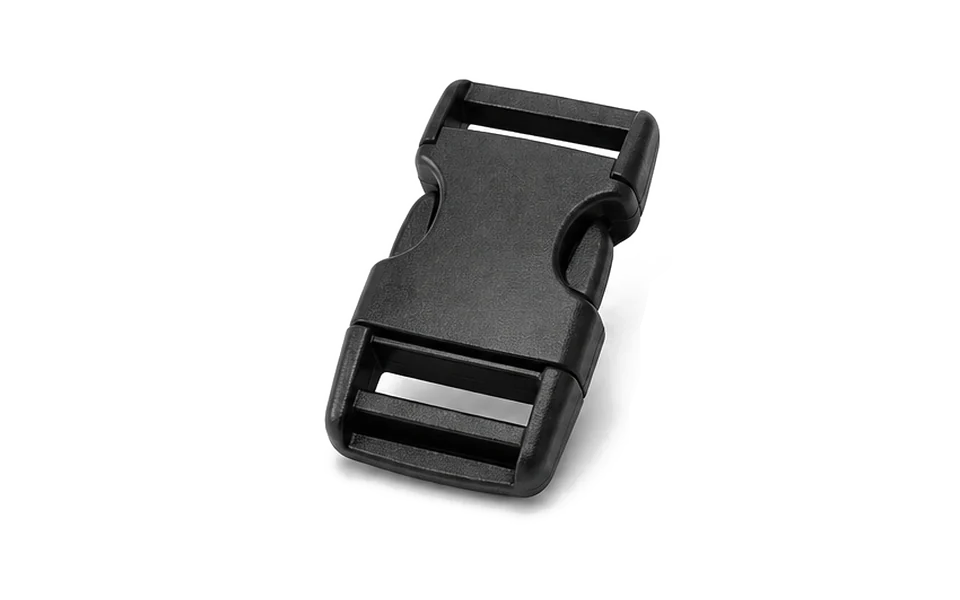
POM is polyoxymethylene, also commonly called acetal in the industry; PA is the general term for polyamide, and what is commonly called nylon falls into this category, with PA6 and PA66 being common types. Both are injection-moldable thermoplastic engineering plastics, so they often appear among the material options for plastic buckles. On this site, the product documentation for side release buckles / side-opening buckles and ladder locks all list POM / PA as available materials (for side release buckles, specifically POM / PA66), and note that the specific material is to be confirmed based on the operating environment and structural requirements.
Publicly available material information describes POM as having an engineering-grade positioning: low coefficient of friction, relatively high stiffness and wear resistance, and good dimensional stability. Descriptions of PA focus more on bulk strength, toughness, and wear resistance; some grade datasheets also mention sliding and damping performance, as well as resistance to various greases and fuels. These are general introductions to the material categories; the material actually used is subject to confirmation by product documentation and samples.
Stiffness and toughness: common tendencies in public information
POM datasheets tend toward stiffness, hardness, and dimensional stability, with a low coefficient of friction. For buckles, this generally corresponds to areas that need to maintain their shape and not loosen after snapping into place, such as latching points that are repeatedly pressed to open and close. These descriptions come from material data sheets and can serve as a reference direction for preliminary material selection.
PA datasheets place more emphasis on strength and toughness, and some grades mention damping, sliding, and wear resistance; for example, Nylon 6 T Natural is described as having good damping, sliding, and wear properties. For buckles, this generally corresponds to areas that need to absorb impact or allow a certain amount of deformation. These differences are common tendencies within the material category, and the performance of specific grades may vary.
How appearance, hand feel, and mating parts are considered together with the material
Both materials support injection molding and can be customized on a project basis for color, dimensions, and markings; the specific surface effect and color are subject to project customization. The surface texture and friction feel of POM and PA may differ depending on grade, additives, and surface treatment. If a buckle needs to be manually opened and closed frequently, it is recommended to press it during the sample stage to experience the rebound and smoothness.
Buckles usually work together with webbing and other components. For buckles such as ladder locks that require the webbing to be threaded back through, the product information notes that openings and connection fit need to be confirmed with actual webbing and other mating parts; therefore, clearly explaining the mating part details helps the factory evaluate the matching of materials and structures.
Final material selection is subject to sample verification.
The differences between POM and PA in the data are mainly in stiffness, toughness, friction, and moisture absorption; there is no simple answer as to which is definitely better. A reliable approach is to first conduct a preliminary material evaluation based on the use environment, then verify buckle engagement, assembly, and actual use performance through samples, and clearly communicate load-bearing and durability testing requirements with the factory. The buckle product information itself states that materials are confirmed according to the use environment and structural requirements, and this should be clarified before quotation and sampling.
Frequently Asked Questions
What data should be requested from the factory when used in humid or outdoor conditions?
Ask the factory to provide water absorption and dimensional data for the target grade under the corresponding environment, and during the sampling stage use samples to compare buckle engagement feel and dimensional changes. The POM entry in the material information lists low moisture absorption as a feature, but water absorption performance is greatly affected by the grade and actual environmental conditions; numerical values taken out of a specific use scenario have limited reference value.
When communicating, it is recommended to explain whether the buckle will be exposed to humid, rain, or high-humidity environments for long periods, and the requirements for consistency of buckle engagement tightness; ask the factory to provide material recommendations for that project. Dimensional changes caused by water absorption are often easier to observe during the sampling stage; test-fitting with actual webbing and the installation method makes it easier to judge suitability than looking only at the material name.
What information is most critical when explaining requirements to the factory?
Talking through the use scenario and load-bearing areas first is more effective than specifying the material first. Buckle product information states that the material can be confirmed between POM and PA66 according to the use environment and structural requirements, so what the factory really needs to know is: what type of bags the buckle is used on, what webbing width it fits, whether it mainly bears tensile load or repeated opening and closing, and whether there are outdoor or humid conditions.
When requesting a quotation, it is recommended to also provide: the width and thickness of the compatible webbing, installation space, buckle position structure requirements, color and appearance requirements, whether it will be used outdoors long-term, and details of mating parts. The product information shows that webbing specifications can be evaluated on a project basis; the installation fit between the buckle body and webbing, adjustment feel, and connection effect are to be confirmed with mating samples; load-bearing and durability requirements need to be confirmed through testing in combination with the actual application.