












When requesting a quote, sending only a photo of a buckle with a one-line note of “backpack buckle” often leads to several rounds of back-and-forth sampling. This article helps buyers clearly specify webbing width, thickness, number of layers threaded through, and mounting position, so that side-release buckles, slider buckles, and D-rings have comparable inputs before customization.
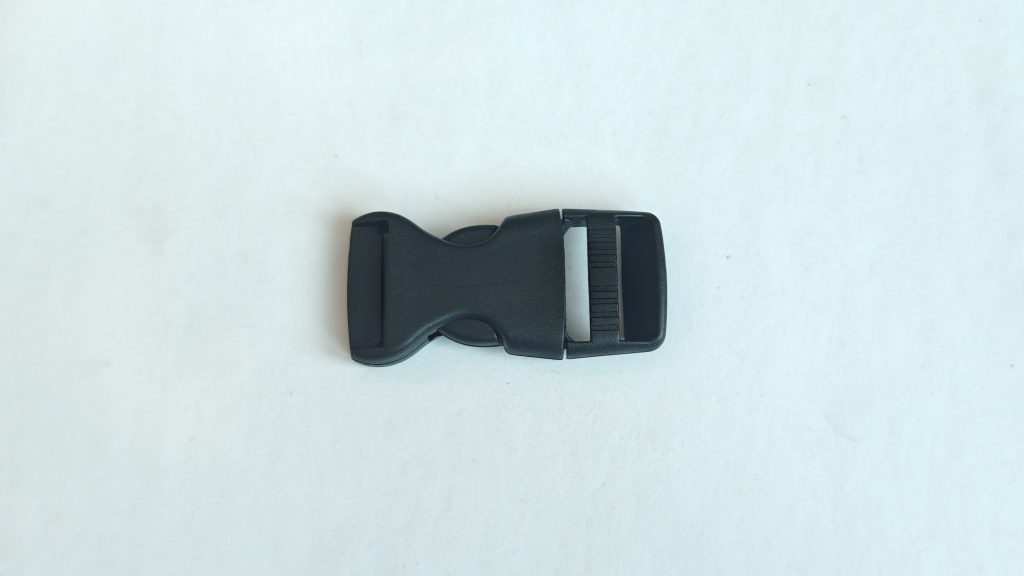
Measuring webbing: report width, thickness, and number of inserted layers together
Webbing width refers to the lateral dimension of the strap when laid flat and placed naturally; avoid stitching, binding, and rolled edges at the measurement points. Different positions on the same strap may deviate, so it is recommended to measure several points and record the range. Thickness is likewise measured in the laid-flat state; do not press and deform soft straps. This is a general practice recommendation; specific results are subject to comparison with the actual product and fastener samples. Width and thickness are the two most basic inputs for matching fasteners, and reporting width alone is often insufficient.
The threading method also affects selection. Webbing may pass through a fastener as a single layer, folded back one layer, or threaded back through two layers; different layer counts require different space in the threading slot. When requesting a quote, stating “strap width × strap thickness × number of inserted layers” is more useful than providing only fastener photos; suppliers can evaluate the slot and assembly plan based on webbing width, thickness, and number of folded-back layers.
How to Read Compatible Width in Fastener Documentation
When reviewing fastener documentation, prioritize the marked compatible webbing width or threading slot width rather than the fastener's overall length and width. For example, a certain side-release buckle with dual slots is marked as suitable for 5–7 mm wide webbing; a certain side-release buckle with ladder-lock adjustment is intended for 1.25-inch wide webbing; a certain buckle with a long adjustment tab is available in 3/4-inch and 1-inch specifications. These are markings for specific models; when requesting a quote, report your webbing width together with the corresponding fastener specification so the supplier can assess the threading space.
Two fasteners with similar shapes may have different threading slot widths and heights, so selection cannot rely on the fastener outline alone. If the strap is too wide, it will not fit into the threading slot; whether the strap matches the slot and whether it skews during adjustment should be judged based on the measured strap width, the compatible width marked on the fastener, and the results of trial threading with samples.
Specify separately by fixed end, adjustment end, and connection end
Fasteners at different positions on the same bag serve different purposes. The side-release buckle consists of a male and female part that mate together for webbing connection and opening/closing; the ladder buckle adjusts strap length by routing the webbing around its center bar and tidies the strap tail; the D-ring provides an attachment point, with the webbing folded back around its straight side to secure it, while the curved part pairs with connectors such as hooks. When ordering, list each by position separately; this is clearer than writing “backpack buckle” generically.
Also specify the webbing threading direction and the number of folded-back layers, as well as the actual mounting position of the fasteners on the bag. The fixed end and the adjustable end have different requirements for the opening gap, so providing position descriptions or a simple diagram lets the supplier evaluate the solutions for both ends.
Customization communication checklist
A complete inquiry usually includes: webbing specifications (width, thickness, surface texture, number of threading layers), fastener type and specification (side-release buckle, ladder buckle, D-ring and their corresponding compatible widths), usage position (fixed end, adjustable end or connecting end), color and appearance requirements, samples or drawings, and any testing requirements the supplier needs to support. Writing these out item by item reduces back-and-forth confirmation.
Boundary notes: Performance such as connection retention force, repeated opening/closing behavior and webbing slippage depends on the specific webbing and fastener combination, and must be verified with matched samples. If used in applications subject to safety regulations, such as baby carriers or personal flotation devices, applicability should be confirmed separately with the buckle supplier.
Frequently Asked Questions
Strap thickness and number of folded-back layers: both D-rings and side-release buckles need to be specified
Yes. D-rings come in widened-slot versions intended for thicker specialty webbing; standard versions must accommodate the folded-back strap through their inner hole dimensions. Measuring the strap thickness and stating how many layers are folded back allows the supplier to judge whether the strap can pass through based on the inner hole and the ring body cross-section.
Side-release buckles and ladder buckles also need strap thickness information. The side-release buckle has an adjustment bar at one end, and the ladder buckle adjusts strap length via its center bar; the strap passage space must be confirmed together with the strap thickness. The fit between strap thickness and opening gap should be verified by actual threading with the real webbing and samples; it cannot be inferred from fastener appearance alone.
Should I attach a webbing sample to the inquiry?
It is recommended to attach an actual webbing sample, or at least specify the width, thickness, surface texture and number of folded-back layers. When the webbing surface is textured, coated or relatively rough, threading resistance and slippage will differ from smooth-surfaced webbing; selecting based only on fastener outer dimensions easily leads to rework.
You may have the supplier trial-thread the fastener according to the sample to confirm whether the strap can be threaded in smoothly and adjusted easily. For material evaluation, the options include thermoplastic materials such as POM and PA; select the material based on use requirements such as snap-leg resilience, buckle-body rigidity, or ring rigidity. The specific grade and its contact performance with the webbing shall be confirmed with the matching sample.